Category management is a strategic approach to procurement that groups related products or services into categories so they can be managed more effectively.
Rather than treating every purchase as an individual transaction, category management looks at the wider picture. Procurement teams analyse spending, supplier markets, business requirements and opportunities across an entire category before developing a longer-term strategy.
A category might include areas such as IT, professional services, facilities management, logistics, marketing, raw materials or temporary labour.
The aim is not simply to reduce costs. Effective category management can help organisations improve supplier performance, manage risk, support innovation and make purchasing decisions that contribute to wider business objectives.
What Is a Procurement Category?
A procurement category is a group of related goods or services that share similar characteristics, suppliers or market conditions.
For example, an organisation might divide its external spending into categories such as:
- IT hardware and software
- Professional services
- Travel and accommodation
- Facilities management
- Marketing
- Logistics and transport
- Packaging
- Raw materials
Larger organisations may divide these categories further into subcategories.
Grouping spend in this way allows procurement professionals to understand the total value being purchased, identify common requirements and develop a coordinated approach to the supplier market.
How Is Category Management Different from Purchasing?
Purchasing is generally concerned with the process of acquiring the goods and services an organisation needs. This can include activities such as raising purchase orders, obtaining quotations and processing transactions.
Category management takes a more strategic view.
Instead of focusing on one purchase at a time, a category manager considers questions such as:
- How much does the organisation spend across this category?
- Which suppliers are currently being used?
- What is happening in the external supply market?
- Where are the main commercial or supply risks?
- Could requirements be consolidated or standardised?
- Are there opportunities for innovation or improved supplier performance?
- What will the organisation need from this category in the future?
This wider perspective allows procurement to plan ahead rather than responding only when a purchase requirement arises.
Why Is Category Management Important?
Category management helps procurement teams make more informed and coordinated decisions.
Better Visibility of Spend
Bringing related purchases together provides a clearer picture of where money is being spent.
This can reveal fragmented purchasing, duplicate suppliers, inconsistent pricing or areas where different departments are buying similar products independently.
More Strategic Supplier Management
Understanding the importance of a category makes it easier to decide which supplier relationships require the greatest attention.
Some categories may benefit from long-term strategic supplier relationships, while others may be better suited to competitive sourcing or a broader supplier base.
Improved Cost Management
Category management can identify opportunities to consolidate spend, negotiate more effectively, reduce unnecessary variation and consider the total cost of ownership rather than simply the initial purchase price.
Reduced Supply Chain Risk
Looking at a category as a whole can help identify dependencies, supply shortages, market volatility and over-reliance on individual suppliers.
Procurement teams can then develop alternative sourcing approaches or contingency plans.
Greater Alignment with Business Objectives
Effective category strategies are based on what the organisation actually needs.
This means procurement decisions can support wider priorities such as sustainability, operational efficiency, service quality, innovation and growth.
What Is the Category Management Process?
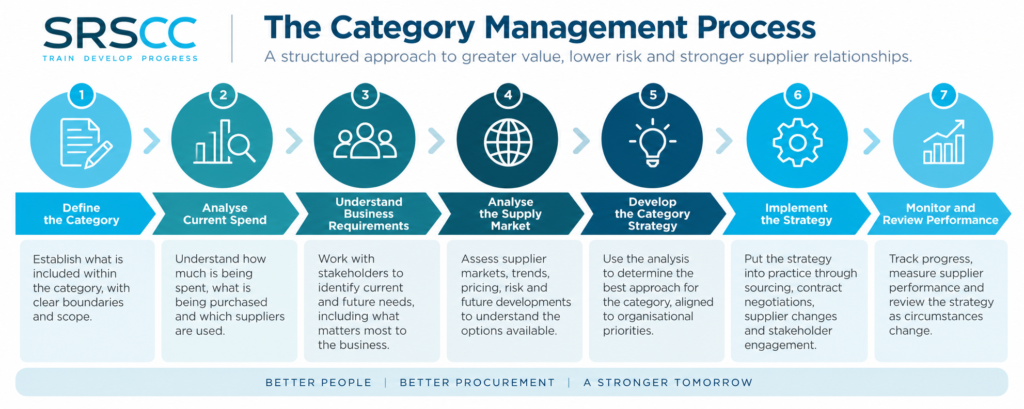
There is no single category management model used by every organisation, but most approaches include several common stages.
1. Define the Category
The first step is to establish what is included within the category.
This may involve grouping products or services according to spend, supplier market, business use or common characteristics.
Clear boundaries help ensure that the category can be analysed consistently.
2. Analyse Current Spend
Procurement teams need to understand how much is currently being spent, what is being purchased and from which suppliers.
Spend analysis may identify:
- Total category expenditure
- The number of suppliers being used
- Purchasing volumes
- Price differences
- Contract coverage
- Buying patterns across different departments
Accurate data provides the foundation for the category strategy.
3. Understand Business Requirements
Stakeholders across the organisation should be involved in defining current and future requirements.
Procurement needs to understand not only what is being purchased, but why it is required and what matters most to the users of those products or services.
This could include cost, quality, availability, service levels, innovation, technical requirements or sustainability.
4. Analyse the Supply Market
Category management also requires an understanding of the external market.
Procurement professionals may consider:
- The number and capability of potential suppliers
- Market trends
- Pricing pressures
- Supply capacity
- Technological developments
- Barriers to switching supplier
- Geographic or geopolitical risks
This helps the organisation understand its position as a buyer and the options available.
5. Develop the Category Strategy
The information gathered during the analysis stages is then used to determine the best approach for the category.
A category strategy might include plans to:
- Consolidate suppliers
- Introduce greater competition
- Negotiate longer-term agreements
- Standardise specifications
- Develop strategic supplier relationships
- Reduce supply risk
- Improve sustainability
- Introduce new technology or innovation
The strategy should reflect both commercial opportunities and organisational priorities.
6. Implement the Strategy
Once agreed, the category strategy must be put into practice.
This may involve sourcing exercises, contract negotiations, supplier changes, stakeholder communication or changes to internal purchasing processes.
Successful implementation often depends on cooperation between procurement and the departments that use the goods or services.
7. Monitor and Review Performance
Category management is an ongoing process rather than a one-off exercise.
Procurement teams should monitor supplier performance, spending, market developments and progress against the objectives set in the strategy.
The category strategy can then be reviewed and adapted as circumstances change.
What Does a Category Manager Do?
A Category Manager is typically responsible for developing and managing the procurement strategy for one or more areas of organisational spend.
Depending on the organisation and category, their responsibilities may include:
- Analysing spend and supplier data
- Researching supply markets
- Developing category strategies
- Working with internal stakeholders
- Planning sourcing exercises
- Negotiating with suppliers
- Managing contracts and supplier relationships
- Monitoring category performance
- Identifying savings and efficiency opportunities
- Managing commercial and supply risks
The role therefore combines procurement knowledge with analytical, commercial, communication and relationship-management skills.
What Skills Are Needed for Category Management?
Category management requires a combination of technical procurement knowledge and interpersonal skills.
Important skills include:
- Data analysis – interpreting spend, supplier and market information to identify trends and opportunities.
- Commercial awareness – understanding how procurement decisions affect cost, value, risk and organisational performance.
- Stakeholder management – working with people across the organisation to understand requirements and gain support for the category strategy.
- Supplier relationship management – developing appropriate relationships with suppliers and monitoring their performance.
- Negotiation and influencing – achieving commercial objectives while maintaining productive working relationships.
- Market analysis – understanding supplier markets, trends, risks and changes that could affect the category.
- Strategic thinking – considering the longer-term needs of the organisation rather than focusing only on immediate purchasing requirements.
Category Management Example
Consider an organisation that spends significant amounts on IT equipment.
Without a category management approach, individual departments might purchase laptops, monitors and accessories independently from several different suppliers.
A category management review could identify:
- Total IT hardware expenditure across the organisation
- The number of suppliers currently being used
- Differences in prices and specifications
- Future equipment requirements
- Supplier performance
- Opportunities to standardise equipment
The resulting category strategy might consolidate purchasing with a smaller number of approved suppliers, introduce standard specifications and negotiate pricing based on the organisation’s total purchasing volume.
However, the strategy could also consider factors beyond price, including technical support, product availability, security requirements, sustainability and the risk of relying too heavily on one supplier.
This illustrates why category management is broader than simply negotiating a discount.
How Can Procurement Professionals Develop Category Management Skills?
Category management often becomes increasingly important as procurement professionals progress into buyer, category management and procurement management roles.
Skills can be developed through a combination of workplace experience, mentoring, professional qualifications and specialist training.
SRSCC’s Category Management Essentials course provides practical training for professionals who want to strengthen their understanding of category management and apply the principles within their organisation.
Professional development through CIPS qualifications can also build broader knowledge across areas including sourcing, supplier relationships, commercial strategy and procurement management.
Category management is also particularly relevant to more advanced professional study, including the CIPS Level 5 Advanced Diploma in Procurement and Supply.